Wednesday, October 24, 2012

Serialized fiction: Everything old is new again

Waiting for the chime of the notification saying "A new chapter is available to download" is completely different from yet very much the same as crowds gathering at the dock to get the latest installment of a Dickens novel unloaded with the london paper.

The updated version:
"Serialized fiction, where episodes are delivered to readers in scheduled installments much like episodes in a television series, has been the subject of an unusual amount of experimentation in publishing in recent months. In September, Amazon announced Kindle Serials, stories sold for $1.99 and published in short episodes that download onto the Kindle as the episodes are released. Three of the first eight serials were produced by Plympton, a new literary studio. "
"In August, Byliner, a digital publisher, announced that it would begin a new digital imprint devoted to serialized fiction, with work by Margaret Atwoodand Joe McGinniss at its start." 
"One of the most talked-about new experiments is taking serialized fiction a step further. Set to make its debut on Monday, it is a novel called “The Silent History” that is available on the Apple iPhone and its iPad. It includes interactive, user-generated elements."
The Victorian version reached its peak with The Old Curiosity Shop, by Charles Dickens.
"The hype surrounding the conclusion of the series was unprecedented; Dickens fans were reported to storm the piers of New York City, shouting to arriving sailors (who might have already read the last instalment in the United Kingdom), "Is Little Nell alive?"
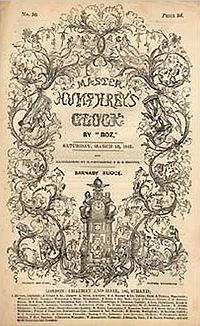
"In 2007, many newspapers claimed the excitement at the release of the last volume The Old Curiosity Shop was the only historical comparison that could be made to the excitement at the release of the last Harry Potter novel, Harry Potter and the Deathly Hallows.[5]"


Monday, September 24, 2012

BarCamp Nashville 2012 #becauseawesome


BarCamp Nashville is awesome for so many reasons. Come to this year's, and:

-- See old friends.
-- Meet new ones.

Our homegrown, free, tech, social media and marketing “unconference” lets anyone sign up to speak (hurry!) and invites everyone who is interested to show up for listening, drinking,  eating, talking,  drinking, networking, drinking, and going to the after-party.

You can choose across simultaneous sessions on the hour, and if you taste it and don't find it delicious, you can visit another one.

If you meet and greet and want to follow up, take it to the bar and make something happen.

There are also "impromptu" rooms for sessions that happen on a whim; those can be extra awesome.

Here's the info you need to make it happen:

When: Oct. 20, 2012
Where: Tequila Cowboy (formerly Cadillac Ranch), 305 Broadway, in downtown Nashville, at 3rd Avenue South.
When: All day and all of the night.

Here's a little history:

The official "BarCamp" brand is both tighter and looser than what Nashville does, and that's okay. The conference here started in 2007, with Marcus Whitney and Dave Delaney recruiting Kelly Stewart and Dean Shortland, who wrangled enough people to speak  from noon to midnight.

The conference has evolved since then, to be bigger and both more broadly and more widely focused on technology, marketing and social media. People come from all angles of those businesses. Add cocktails and stir.

See you there.

UPDATE: Thanks for visiting, all you all. These are the browsers you smart people are using:


Saturday, August 25, 2012

Neil Alden Armstrong (August 5, 1930 – August 25, 2012)

 New York Times obituary today for the first astronaut to walk on the moon:
Neil Armstrong, inside the lander after the moonwalk on July 20, 1969.
"Mr. Armstrong commanded the Apollo 11 spacecraft that landed on the moon on July 20, 1969, capping the most daring of the 20th century’s scientific expeditions. His first words after setting foot on the surface are etched in history books and the memories of those who heard them in a live broadcast. 

“That’s one small step for (a) man, one giant leap for mankind,” Mr. Armstrong said."

I was a child then, watching in the living room, in black-and-white, way past bedtime.

This month, when #Curiosity landed on Mars, I was an adult, watching livestreaming on my laptop, way past bedtime.

Here are images and text, from the NASA archives.

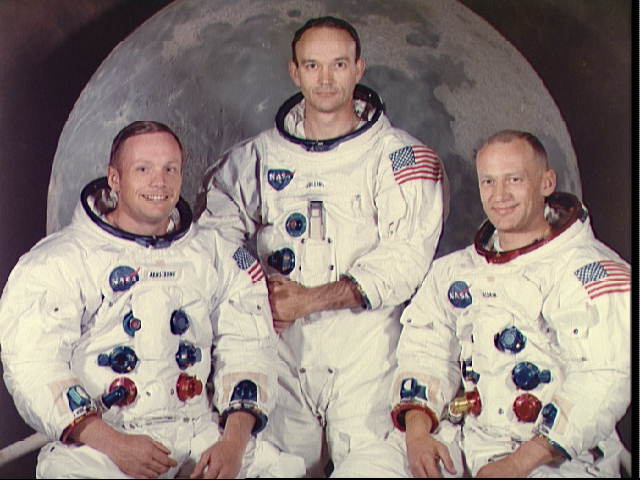
The crew of Apollo 11:

Commander Neil A. Armstrong
Command Module pilot Michael Collins
Lunar Module pilot Edwin E. Aldrin, Jr. 
May 1, 1969. (NASA photo ID S69-31739)

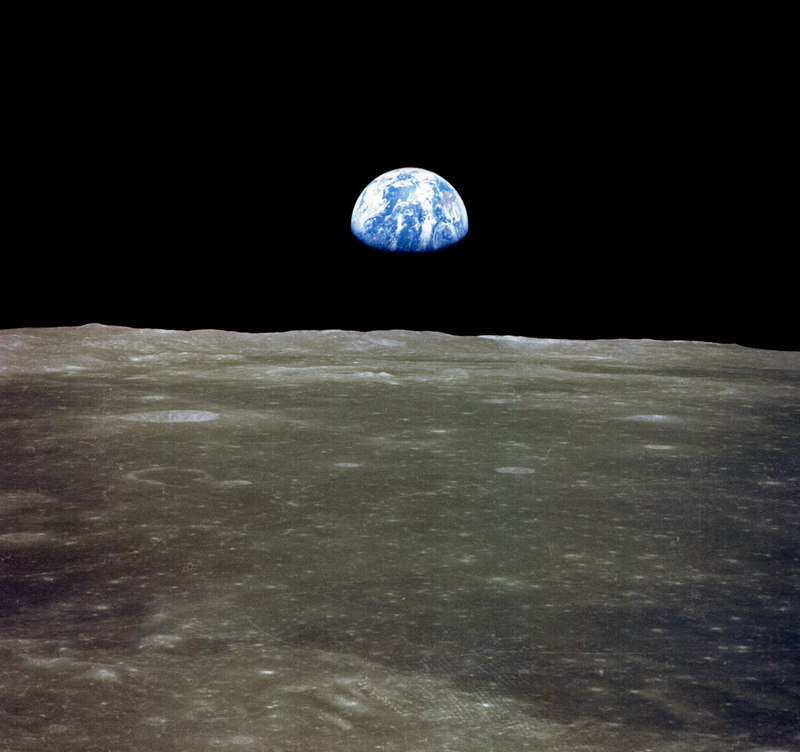
On July 20, 1969, after a four day trip, the Apollo astronauts arrived at the Moon. 

This photo of Earthrise over the lunar horizon taken from the orbiting Command Module is one of the most famous images returned from the space program, although even the astronauts themselves cannot remember who actually took the picture. 

The lunar terrain shown, centered at 85 degrees east longitude and 3 degrees north latitude on the nearside of the Moon is in the area of Smyth's Sea.

(NASA photo ID AS11-44-6552)

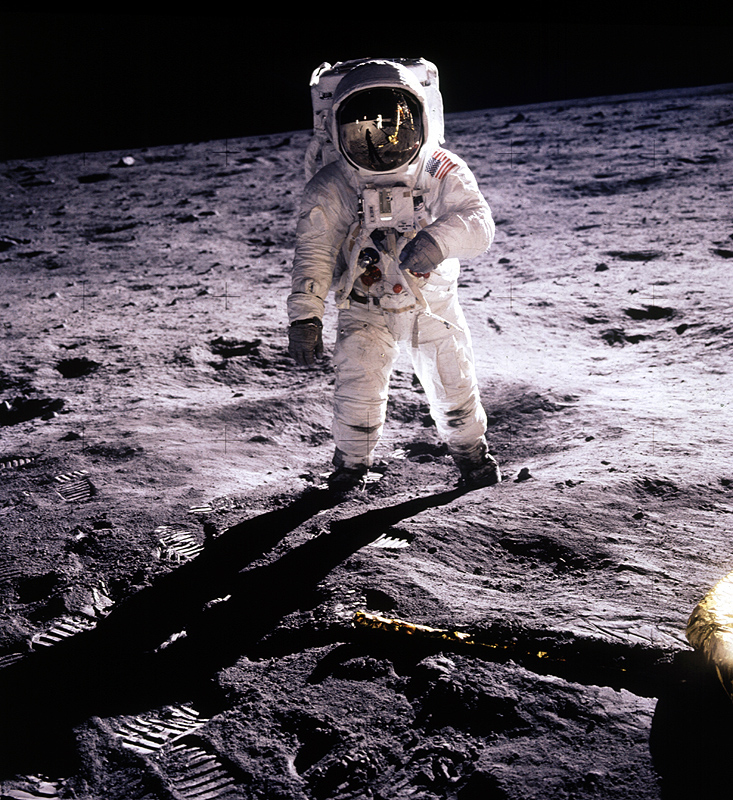
Neil Armstrong took this picture of Edwin Aldrin, showing a reflection in Aldrin's visor of Armstrong and the Lunar Module.  This is one of the few photographs showing Armstrong (who carried the camera most of the time) on the Moon.

 The tasks assigned to both astronauts were carefully choreographed and practiced back on Earth, and Aldrin was busy setting up scientific experiments among other responsibilities. 

Apparently taking pictures was not as carefully planned. Aldrin later said, "My fault, perhaps, but we had never simulated this in training."
(NASA photo ID AS11-40-5903)

Thursday, August 23, 2012

Oh, The Places You'll Go :: Travel #ux

Travel is wonderful for seeing #ux things. Here is an annotated gallery, with  thought experiments:

1.  How many ways are there to design a shower/tub faucet?
a.  There are an infinite number of ways, as is evidenced by looking at online hardware offerings or visiting your local boutique, mall or big-box home decor store.

b. There are two ways: the right way and the wrong way.
Hint: If you need to put a sign on it to tell people how it works, it's the wrong way.


2. How do you eat bread?
a.  By following the "Bread Instructions"

b. Slice, serve, store. Repeat.
Hint: Instructions that say they are "easy to follow" often aren't.


3. What should you do if the elevator gets stuck?

a. Do not become alarmed, but do press the button marked "alarm."

b. Distinguish the red button marked "alarm" from any other possible buttons marked "alarm."

c. Use telephone: Mine? Yours? Theirs?

Hint: Italics are not the right face for urgent information. Also, omit needless words.


Friday, August 10, 2012

"Hope" is the thing with feathers¹ :: Also, plutonium

The project that landed #Curiosity on Mars started a decade ago. A new scientist working on the team set her course for this future years earlier; an experienced scientist working on it steered by that star even longer.

That's a lot of hope.²

Also, plutonium: The rover is powered by a radioisotope thermoelectric generator, whose heat produces electricity and keeps #Curiosity warm in the -150°F Martian night.³

Getting ready
Climbing hills
#becauseawesome

Notes
  1. “Hope” is the thing with feathers
    By Emily Dickinson
    “Hope” is the thing with feathers 
    That perches in the soul 
    And sings the tune without the words 
    And never stops - at all 
    And sweetest - in the Gale - is heard 
    And sore must be the storm 
    That could abash the little Bird
    That kept so many warm 

    I’ve heard it in the chillest land 
    And on the strangest Sea 
    Yet - never - in Extremity,
    It asked a crumb - of me.
     
  2. More than three million people watched the #Curiosity landing live on Ustream, according to the web platform, with feeds from NASA HDTV, NASA JPL and NASA JPL 2.

  3. Plutonium decay heats #Curiosity and other robotic space machines. Plutonium was also used in "Fat Man," the nuclear bomb detonated over Nagasaki, on August 9, 1945, three days after Hiroshima was destroyed by the uranium-based "Little Boy."

Monday, August 6, 2012

Morse code :: Visual odometer

The awesome from Curiosity is so deep and so wide.

Today's piece of space trivia: the treads cut into the wheels to mark its trail with a "visual odometer" spell out JPL in Morse Code.


"J P L," in Morse Code = visual odometer

Mars :: Again, and Better

So much awesome when our powers are used for good. 

1969: Apollo 11 lands on the moon. The technology is a fraction of what an iPhone has, but it works. I was a child, watching on television in the living room; the signal came from the antenna on the roof of the house.

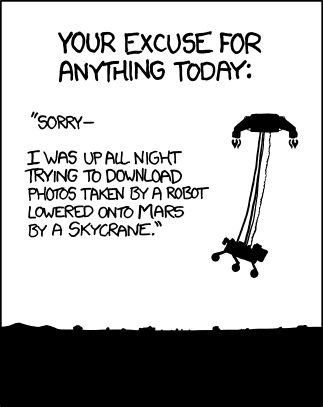
2012: Curiosity lands on Mars. The technology is "the most challenging mission ever attempted in the history of robotic planetary exploration."  I watch on a glass and metal machine from the future, in my lap, my child asleep beside me, as a  jet-fired hover crane lowers a robot the size of a Mini Cooper, onto Mars -- who emails us photos, from the other side of the sun.

The Gemini and Apollo programs made me love space, science, and tech; I hope does this for kids everywhere, today and tomorrow.

@MarsCuriosity is hilarious, smart and funny: perfect social media voice for the journey.

"is the central defining human attribute"
Lots of amazing photos:

As seen on live streaming, the visualized animation:

Mission Control
Landing a robot on Mars :: Instant meme


Meme

 The dots and dashes cut into the wheels spell JPL in Morse code.


The internet started as a government program; NASA and science are government programs for the future.